

Today, 3 August 2026, we reached another important milestone in the development of prEN 40000-1-3: Cybersecurity requirements for products with digital elements – Part 1-3: Vulnerability handling.
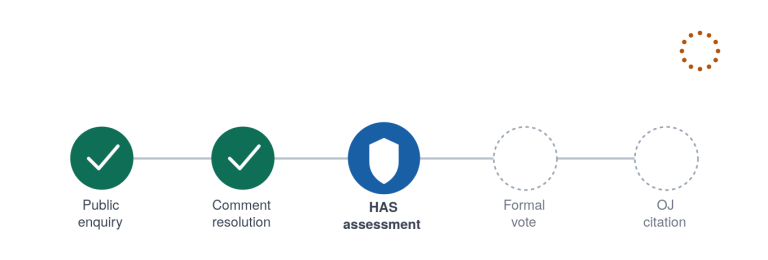
After several months (~4 Months) of comment resolution and technical review, the document has now been submitted to the European Commission (EC) for the pre-Formal Vote HAS assessment, the final technical review before Formal Vote. The pre-Formal Vote HAS assessment review provides an early indication of whether any issues remain that could affect the future citation of the standard in the Official Journal of the European Union.
(If you’re curious about the full process and stages behind EN standard development within CEN and CENELEC, this is a good reference: BOSS — Guidance on the standard development process.)
As Rapporteur of CEN/CLC/JTC 13 Working Group 9, it has been a privilege to work alongside experts from across Europe to develop what is expected to become one of the key horizontal harmonised standards supporting the implementation of the Cyber Resilience Act (CRA).
The standard evolved significantly during development
prEN 40000-1-3 was in Public Enquiry (stage code 30.90 – submission to Enquiry) from 11 December 2025 until 05 March 2026 (stage code 40.60 – close of Enquiry voting), during which we received comments from the National Members (1,743) and the Commission (193); a combined 1,936 comments to resolve. Formally, we started the comment resolution on 18 March 2026 and completed it on 31 July 2026, while we completed the last editorial work today, 3rd August 2026.
Every comment received a documented response, whether accepted, partially accepted, or rejected with technical justification. This is one of the strengths of the European standardisation system: every technical concern must be considered, debated, and resolved transparently.
During this period, we also went through an additional three rounds of review within Working Group 9, resolving a further 266 comments internally and bringing the total number of comments handled to 2,202. This additional internal review ensured the buy-in of the full WG9 delegation and maximised confidence in the draft before it was handed over to the Commission.
The result is not simply a revised document; it is a significantly more mature and technically consistent standard.
Between the first working draft and today’s version, the document increased from approximately 10,700 words to more than 17,600 words, reflecting additional technical guidance, clarified requirements, improved conformity assessment provisions, and stronger alignment with the Cyber Resilience Act.
Here’s what that process actually changed, and why it matters.
Over 2,000 comments, and a genuinely collaborative process
The draft went through formal review by CEN/CENELEC’s HAS Consultants and National Members, and internal WG9 review, with 2,202 individual comments in total, each requiring a documented response: accept, partially accept, reject with reasoning, or note for a future version. About two-thirds of the feedback led directly to changes in the text.
That volume of scrutiny is exactly what you want in a standard that’s going to underpin legal presumption of conformity. It’s slower, but it’s how you catch the gaps that matter before they become gaps in someone’s production compliance program.
A few of the changes that came directly out of that process:
A simpler risk model. The early draft included a whole separate “Applicability” phase dedicated to something called “Requirement Enhancements”, an extra layer of risk-tiered obligations manufacturers had to work out whether they needed. Following the review process, the enhancement mechanism was removed entirely. Instead of creating multiple requirement tiers, the standard now adopts a single, coherent set of vulnerability handling requirements that manufacturers apply proportionately using their own cybersecurity risk assessment under the CRA. The result is a document that is simpler to implement, easier to audit, and more closely aligned with the regulatory framework.
A new annex mapping every requirement to the risk it addresses. A process standard like this one should make its own logic visible: why does this requirement exist, and what happens if you skip it? The finalized standard now includes an informative annex doing exactly that: every vulnerability handling activity mapped to the risk it mitigates, so manufacturers can reason about proportionality using their own risk assessment rather than guessing.
Real support for multi-party disclosure. Modern software products increasingly depend on open-source software, commercial components and complex supply chains. Reflecting this reality, the standard now provides stronger support for multi-party coordinated vulnerability disclosure, incorporating concepts from ISO/IEC TR 5895 throughout the vulnerability handling lifecycle. This better reflects the collaborative nature of vulnerability handling under the CRA, where manufacturers frequently interact with suppliers, researchers, maintainers and downstream stakeholders.
A consistent distinction between third-party and non third-party components. This is probably the most substantive technical shift between the first draft and the final version, and it runs through the whole document rather than sitting in one clause. The early draft applied uniform rules regardless of where a component came from. The finalized standard consistently separates what a manufacturer controls from what they don’t, and applies full rigor to the former, a lighter reference-based path to the latter. It shows up in three places:
- Component identification. The old SBOM rule was flat: identify at least the top-level dependencies, full stop. Now, non third-party components, the code the manufacturer actually writes and controls, must be completely identified and documented, with the conformity assessment explicitly requiring evidence of that completeness. Third-party components only need to be identified at least at the directly-integrated level, reflecting the practical reality that manufacturers often can’t obtain full transitive-dependency data from every upstream supplier.
- Verification. A new requirement means that where a vulnerability sits in a third-party component, is fully mitigated by an available remediation, and that remediation has been applied, several otherwise-mandatory downstream steps become optional. In plain terms: if you’ve installed the upstream vendor’s patch, you don’t need to run your own full internal risk-assessment and remediation-decision paperwork on a vulnerability someone else has already fixed.
- Release advisories. For vulnerabilities in a manufacturer’s own components, the published advisory must be fully detailed, description, identifiers, dates, severity, impact, remediation guidance, contact information. For third-party component vulnerabilities, the manufacturer can instead reference the third party’s own published advisory or the updated version, rather than duplicating information they didn’t produce.
The same pragmatism shows up in hardware identification. The early draft required identifying every hardware component integrated in the product; the final version scopes this to components directly contained in the product, promotes component version from an optional extra to a mandatory recorded field, and adds a practical fallback: where the required information isn’t available or sufficient, the manufacturer documents whatever information does support vulnerability handling. That’s a requirement written by people who have actually tried to get complete component data out of a hardware supply chain.
Direct traceability to the CRA’s legal text. The standard’s Annex ZA, the table that ties each clause back to a specific essential requirement in Annex I of the CRA, is what actually allows this document to grant presumption of conformity once it’s cited in the Official Journal. Getting that correspondence table right, cleanly structured and complete, was one of the most detail-heavy parts of the review process, and it’s now fully in place.
A standard that stands on its own. Earlier drafts leaned on a companion standard (Part 1-2) as a normative dependency, which would have meant manufacturers needed both documents just to claim conformity with this one. That dependency has been removed; prEN 40000-1-3 is now self-contained, referencing other standards only informatively. This significantly improves usability for manufacturers implementing vulnerability handling processes.
Overview of the major improvements compared with the earlier draft
The review process resulted in several notable structural improvements.
| Earlier Draft | Current Draft |
|---|---|
Requirement Enhancements | Removed |
Limited multi-party vulnerability handling | Integrated throughout the lifecycle |
Less structured conformity assessment traceability | Expanded, clarified and added traceability by requirement and assessment |
Limited consistency between activities | Harmonised inputs, outputs and dependencies |
Fewer informative annexes | Additional annexes supporting implementation and assessment |
Dependency on Part 1-2 | Removed |
Taken together, these changes significantly improve the usability of the standard while maintaining alignment with the objectives of the Cyber Resilience Act.
The structure itself got leaner, not just clearer
Comparing the very first working draft to today’s version clause by clause shows something the word-count growth alone doesn’t: the document actually has fewer clauses now than it started with, 22, down from 26, even though it says more. Two phases account for almost all of that consolidation.
Preparation went from ten sub-clauses to eight. The most telling example: the original draft had a standalone clause called “Secure communication,” tagged as a Requirement Enhancement. The restructuring resolved it by folding it into the new “Confidentiality of vulnerability information” clause, where providing a secure communication mechanism remains a recommendation, but if a manufacturer does implement one, publishing it and keeping it accessible becomes a firm requirement. Optional to adopt, mandatory to do properly once adopted. A separate “Product identification” clause was absorbed the same way, consolidating into what are now clearly-scoped software and hardware component identification requirements
Receipt went from seven sub-clauses to six, for a similar reason. The original draft had a standalone “Coordinator involvement” clause, a single, thin recommendation about optionally bringing in a coordinator for complex multi-party cases. That’s gone as a standalone clause too, not because the concept was dropped, but because coordinator involvement is now woven directly into the surrounding requirements, consistent with treating multi-party disclosure as the default assumption rather than a special case handled in one corner of the document.
Verification, Remediation, Release, and Post-release, by contrast, kept exactly the same clause structure from the first draft to the last, eight clauses combined, unchanged. That part of the process model was evidently right from the start; nearly all of the structural rework happened at the front end, in how manufacturers prepare for and receive vulnerability reports, not in how they act on them once verified.
Why does this matter?
The Cyber Resilience Act becomes applicable on 11 December 2027.
Manufacturers placing products with digital elements on the European market will need documented and auditable vulnerability handling processes covering activities such as:
- coordinated vulnerability disclosure;
- vulnerability intake;
- vulnerability verification;
- remediation planning;
- software bill of materials (SBOM) management;
- security update release;
- vulnerability information publication;
- post-release monitoring.
Rather than interpreting the legal requirements directly from the Regulation, manufacturers will be able to rely on harmonised standards that translate those legal obligations into practical, assessable technical requirements. That is precisely the role prEN 40000-1-3 aims to fulfil.
Looking ahead
Submission to the European Commission for the pre-Formal Vote HAS assessment marks another important milestone, but the work is not yet complete.
Following this review, the draft is expected to proceed to Formal Vote, after which the European Commission will determine whether, and under what conditions, the standard can be cited in the Official Journal to support presumption of conformity with the Cyber Resilience Act.
Developing harmonised standards is a truly collaborative effort involving experts from across Europe, National Standardization Bodies, industry, public authorities and the European Commission.
It has been an honour to contribute to this work as Rapporteur, and I would like to sincerely thank all members of CEN/CLC/JTC 13/WG 9, the National Delegations, the HAS Consultants and the many experts whose technical contributions have helped shape this document.
The journey towards harmonised standards supporting the Cyber Resilience Act is entering its final stages.
Over the coming months I will continue sharing insights into prEN 40000-1-3, the wider prEN 40000 series, and what these developments mean for manufacturers preparing for CRA compliance.
This article reflects the status of prEN 40000-1-3 as of the publication date above. The standard is still under development, and its content, structure, and requirements may change before Formal Vote and eventual citation in the Official Journal of the European Union. This article is provided for informational purposes only and does not constitute legal advice.
If your organization is preparing for the Cyber Resilience Act and would like to evaluate the maturity of its vulnerability handling process, feel free to get in touch. Vulnir is helping manufacturers translate regulatory requirements into practical implementation and conformity assessment readiness.
The next few months will be particularly important, not only for this standard, but for the entire European cybersecurity regulatory landscape.